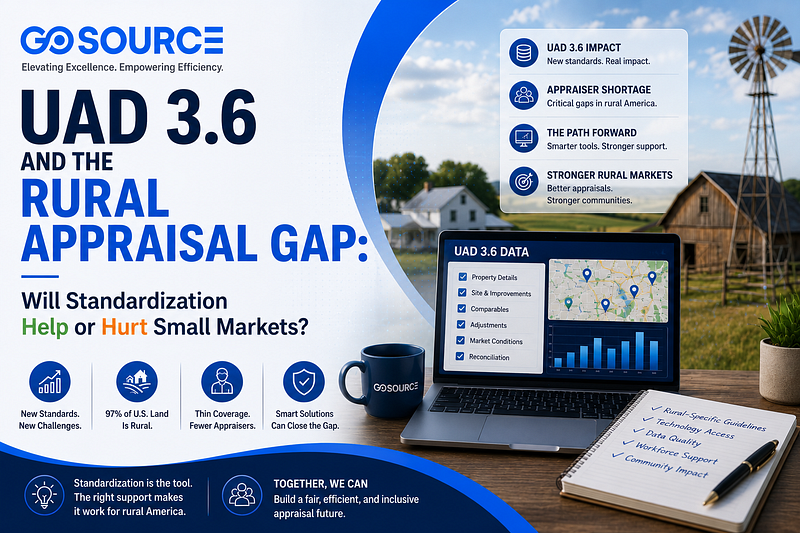
Meta Description: UAD 3.6 was built for suburban markets. But 97% of US land is rural, and the new appraisal data standard creates unique challenges for thin-market appraisers. Here’s what the industry needs to address.
Meta Keywords: UAD 3.6, UAD 3.6 rural appraisal, uniform appraisal dataset rural, UAD 3.6 compliance, appraisal shortage rural, UAD 3.6 thin markets, appraisal data standards
Every headline about UAD 3.6 references the same landscape: digital pipelines, automated validation, XML submissions, API connectivity, and faster lender workflows. The implicit setting is a suburban market with dense, comparable sales data, multiple active appraisers, and modern technology infrastructure. That is the world the new standard was built in, the world it fits most naturally, and the world that dominates the industry’s implementation of conversation.
The United States, however, is overwhelmingly rural by geography. And rural appraisal markets operate by a fundamentally different set of conditions. Comparable sales may be scattered across a 40-mile radius. Properties routinely include agricultural improvements, timber rights, water access, and mineral interests that no standardized dropdown field was designed to capture. A single appraiser may serve an area for the size of Rhode Island. The MLS data density that UAD 3.6’s automated validation logic assumes as a baseline simply does not exist in these markets.
The question the industry needs to start asking loudly, and with urgency, is whether UAD 3.6’s drive toward standardization will serve rural appraisers and the communities they support or introduce new compliance friction that accelerates an already critical appraiser shortage in America’s small markets.
The Crisis That Precedes UAD 3.6
Before examining what UAD 3.6 means for rural markets, it is essential to understand the baseline into which the new standard arrives. Rural appraisal has been in structural decline for years. The US appraiser workforce is aging and shrinking, with the average certified residential appraiser now past 55 years old. New entrants to the profession face a demanding credentialing pathway, and the economics of rural practice make the investment particularly difficult to justify, as it does not adequately compensate for the additional complexity.
The result is that in many rural counties, appraiser coverage is dangerously thin. In some cases, a single appraiser serves a geographic area that would contain dozens of practitioners in a comparable suburban market. In others, there is no local appraiser at all, forcing lenders to import out-of-area appraisers who may lack genuine market familiarity.
USDA rural development loans, FHA financing, and conventional rural mortgages all face routine delays of four to six weeks in underserved markets. Those delays translate directly into failed real estate transactions, reduced rural homeownership rates, and diminished economic mobility for communities already managing significant resource constraints. UAD 3.6 enters this environment, and the critical question is whether its compliance demands make this situation better or worse for the practitioners who remain.
Where UAD 3.6 Creates Friction for Rural Markets
The Comparable Data Assumption Problem
UAD 3.6’s automated validation logic was built on an assumption that seems so fundamental it is almost invisible: that sufficient comparable sales data exists in a market to validate adjustment ranges against statistical benchmarks. In a suburban market with 300 comparable sales recorded in the past 12 months within a two-mile radius, this assumption is unproblematic. In a rural county where three comparable sales exist within a 35-mile radius and two of those are from 18 months ago, automated validation flags become adversarial to the practitioner and meaningless as quality signals.
Rural appraisers do not have the luxury of abundant comparable data. They work in thin markets where professional judgment is not a supplement to data analysis; it is the primary analytical tool. UAD 3.6’s structured validation systems were not designed with this reality in mind, and without specific accommodation language from the GSEs, rural practitioners face the prospect of generating compliance flags that reflect market conditions rather than appraisal errors. Managing and explaining those flags will add time and cost to every rural assignment.
Agricultural and Complex Property Features
Rural properties routinely include characteristics that UAD 3.6’s standardized field vocabulary was not designed to capture with adequate precision. Water rights and water delivery infrastructure. Timber value on forested acreage. Agricultural outbuildings, barns, equipment sheds, and grain storage have economic value that a residential appraisal form has never been cleanly accommodated. Mineral rights. Conservation easements. Seasonal road access conditions. Well and septic systems on large acreage
properties,
Each of these features requires narrative analysis and professional judgment to be valued correctly. The risk in UAD 3.6 is that appraisers in rural markets are pressured toward oversimplification, forcing genuinely complex properties into standardized field structures that do not reflect their actual characteristics. A 200-acre property with productive timber stands, two operating wells, and a conservation easement limiting development rights is not adequately described by the same dropdown fields that apply to a 3-bedroom ranch on a suburban quarter-acre lot. When the format cannot accommodate the property complexity, the resulting report is less accurate than a perverse outcome for a standard designed to improve data quality.
Technology Infrastructure and Compliance Cost
UAD 3.6 compliance requires software upgrades, training investment, and reliable high-speed broadband for API submission workflows. For an AMC or large lender processing of 2,000 appraisals per month, these are manageable infrastructure investments that spread across high volumes. For a solo rural appraiser completing 70 to 90 assignments per year, often in areas where broadband connectivity is itself a challenge, the economics look entirely different.
The compliance cost burden of UAD 3.6 falls most heavily on the smallest practitioners, exactly the practitioners serving the markets where the appraiser shortage is most acute. If the transition to UAD 3.6 results in solo rural practitioners reducing their volume, retiring early, or exiting the profession rather than managing a compliance investment that does not pencil out against their fee structure, the rural appraisal gap widens further. This is not a hypothetical concern. It is the rational economic behavior of small businesses confronting a mandatory infrastructure cost with no revenue offset.
Policy Watch UAD 3.6 Rural Accommodation: As of mid-2026, Fannie Mae and Freddie Mac have not released rural-specific accommodation guidelines for UAD 3.6 validation logic or complex rural property types. The Appraisal Institute, the American Society of Farm Managers and Rural Appraisers (ASFMRA), and the American Society of Appraisers are actively engaging the GSEs on these issues. Rural practitioners should monitor official GSE guidance, participate in professional association comment processes, and maintain direct communication with their software vendors about thin-market validation handling.
Where UAD 3.6 Can Genuinely Help Rural Markets
A balanced assessment requires acknowledging that UAD 3.6 creates real opportunities for rural market improvement, not despite standardization, but because of it.
Potential benefits for rural markets:
- Structured data helps USDA and FHA identify rural supply gaps with greater speed and precision
- Clean XML submissions reduce revision cycles with lenders unfamiliar with rural property types
- Standardized terminology reduces confusion when out-of-area appraisers service rural assignments
- API-ready architecture supports desktop and hybrid appraisal models that can extend rural coverage
- Consistent data fields make rural portfolio analysis and policy advocacy more evidence-based
Ongoing risks without rural accommodation:
- Automated validation will fire inappropriately in thin-data markets, creating a workload without value
- Complex agricultural and rural property features are poorly served by current field definitions
- The compliance investment burden hits solo rural practitioners hardest on a per-assignment basis
- Workflow disruption risk is highest during transition for practitioners with no IT support staff
- Standardization pressure may reduce narrative depth for properties that require it most
The most significant rural opportunity in UAD 3.6 lies in its support for desktop and hybrid appraisal models. The standard’s API-ready architecture, structured data submission, and digital workflow design make it easier to separate the property inspection component of an appraisal from the valuation analysis, an important distinction for rural markets where bringing a fully credentialed appraiser to every property site is the primary logistical constraint.
Desktop appraisal models, properly structured with appropriate safeguards, could allow qualified appraisers to extend their geographic reach in rural markets, providing professional valuation analysis while relying on local data collectors or property condition certifications for the inspection component. This is not a replacement for traditional appraisal in complex rural assignments. It is a tool that, applied appropriately, could meaningfully expand coverage in markets where full-inspection appraisal capacity has become genuinely scarce.
What UAD 3.6 Means for Rural Homebuyers and Communities
The rural appraisal gap is not an abstract policy problem. It is a concrete barrier to homeownership for millions of Americans in small towns, agricultural communities, and non-metropolitan areas. When appraisal delays run four to six weeks, sellers accept other offers or renegotiate terms. When no local appraiser is available, out-of-area practitioners unfamiliar with local market nuances produce reports that lenders scrutinize more intensively, creating additional delays. When appraisal costs rise to cover extended drive times and compliance overhead, more borrowers are priced to the margins of affordability.
UAD 3.6’s rollout will either improve or worsen these conditions, depending on whether rural accommodation is built into the standard implementation or retrofitted after the damage is visible. The window for proactive policy design is closing. The time to influence the GSEs’ rural accommodation guidance is during implementation planning, not after practitioners are already navigating a poorly fitted compliance framework.
Concrete Actions for Rural Practitioners and Their Clients
The policy of conversation is ongoing, but practitioners in rural markets cannot afford to wait. There are specific, actionable steps available now:
- Engage professional associations with field-level data. The Appraisal Institute, ASFMRA, and ASA are all actively engaged in UAD 3.6 rural accommodation advocacy. The most powerful input to those conversations is specific, documented examples of how thin-market conditions interact with UAD 3.6 validation logic. Your field experience is a primary source of data that policymakers cannot generate themselves; submit it through formal comment processes.
- Have a detailed conversation with your software vendor now. Generic UAD 3.6 compliance claims from vendors do not address rural-specific issues. Ask specifically: How does the system handle comparable searches with fewer than five results? How does the validation logic accommodate time-adjusted sales beyond 12 months? What fields are available for agricultural improvements and rural property features? If your vendor cannot answer these questions, press harder or evaluate alternatives.
- Document thin-market validation flag patterns systematically. When UAD 3.6 validation flags fire for reasons attributable to market conditions rather than appraisal errors, note it. Build a documentation practice around these instances from the start of your UAD 3.6 implementation. Pattern data from rural practitioners is essential evidence for GSE accommodation requests and software vendor development priorities.
- Evaluate AMC and technology partnerships for rural market fit. Not all AMC relationships are equal for rural appraisers. Partners with rural market experience, the operational capacity to manage UAD 3.6 compliance infrastructure, and the review expertise to understand complex rural property types can absorb compliance overhead that would otherwise fall entirely on the individual practitioner. The right partnership materially changes the economics of rural UAD 3.6 compliance.
- Begin technology investment planning with a rural lens. If you know broadband connectivity is a constraint in your market, plan for offline-capable workflow solutions now. If your current appraisal software has not released a UAD 3.6 rural compliance roadmap, ask for one in writing. The transition timeline will not wait for practitioners who begin planning after the deadline pressure has already arrived.
The Standard Is a Tool. Its Impact Depends on Who Designs the Implementation
UAD 3.6 was developed to solve real and well-documented problems in residential appraisal data: inconsistency, PDF-format limitations, manual processing bottlenecks, and the growing gap between appraisal data and modern mortgage technology. The standard addresses these problems effectively in the markets it was designed for.
The question is whether it will serve the full geographic reality of the US mortgage market, including the hundreds of billions of dollars in annual rural mortgage volume and the millions of American families whose homeownership depends on functioning appraisal markets in thin-data counties.
Rural appraisal is not a marginal edge case; it is a systematically underserved segment of a critical market, already under structural stress, now facing a major compliance transition that was not designed with its specific conditions in mind. The responsible path is not to slow UAD 3.6 or exempt rural markets from its requirements. It is to accelerate the development of rural-specific accommodation guidance, build thin-market protocols into validation logic, ensure that complex rural property types are adequately represented in the standard’s field vocabulary, and make the compliance cost burden manageable for the solo practitioners who serve the markets the GSEs are most at risk of losing.
Standardization is a tool. Whether it strengthens or weakens rural America’s mortgage market depends entirely on whether the organizations designing its implementation are paying close attention to what happens at the geographic margins.
Frequently Asked Questions About UAD 3.6 and Rural Appraisal
Does UAD 3.6 apply to rural properties? Yes. UAD 3.6 applies to all residential mortgage transactions delivered to Fannie Mae and Freddie Mac, including properties in rural and non-metropolitan markets. There is currently no formal rural exemption, though GSE accommodation guidance for thin-market conditions and complex rural property types is anticipated as implementation proceeds.
How does UAD 3.6 affect appraisals for agricultural properties? Agricultural properties with outbuildings, irrigation systems, water rights, or timber value present challenges for UAD 3.6’s standardized field structure, which was primarily designed around residential property types. Appraisers working on these assignments should work closely with their software vendors to understand available fields for complex rural improvements and should document additional analysis in narrative sections where standard fields are insufficient.
Will UAD 3.6 make the rural appraiser shortage worse? Without intentional policy intervention, including GSE accommodation for thin-market validation logic and manageable compliance cost structures for small practitioners, there is a genuine risk that UAD 3.6’s compliance burden accelerates attrition among rural appraisers. Industry associations are actively engaging the GSEs on this issue. Practitioners and their clients should support those advocacy efforts and monitor developments closely.
Can desktop appraisals help address the rural shortage under UAD 3.6? Desktop and hybrid appraisal models, enabled in part by UAD 3.6’s structured data architecture, offer genuine potential to extend professional appraisal coverage in rural markets. These models allow qualified appraisers to provide valuation analysis without requiring a full-inspection trip to every property with a significant logistical advantage in markets where geographic coverage is the primary constraint.
Read more: What Is UAD 3.6? Complete Guide to the Future of Appraisal Reporting
Explore more articles: Go Source Valuation Blog